
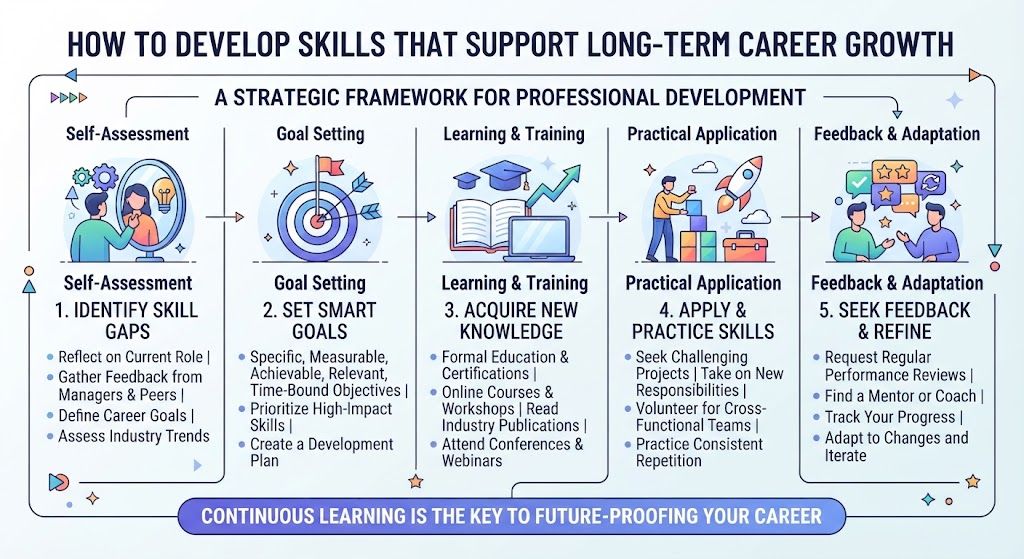
Key Takeaways
- Long-term careers need a mix of technical skills and human skills.
- Learning a little every week beats occasional intense study bursts.
- Feedback and mentors accelerate growth faster than solo effort.
- Track your wins, because proof of skill matters more than claims.
- Review your skill plan yearly as your industry changes.
Careers last decades, but most people plan their skills one project at a time. This works until the market shifts. Then, years of comfortable routine suddenly leave a resume outdated. The world of work changes quickly now. The World Economic Forum reports that a large share of core job skills will change in the coming years. Consequently, the professionals who thrive are the ones who keep learning on purpose.
Skill development for career growth is not about collecting certificates. It is about building a small set of abilities that stay valuable across jobs and industries. Additionally, it is about knowing which skills to invest in and which to skip.
This guide explains how to build those skills step by step. You will learn which skill categories matter most, how to practice efficiently, and how to turn ability into visible career progress. By the end, you will have a working plan you can start this week.
Step 1: Identify the Skills That Actually Matter
Not all skills deserve your limited time. Therefore, the first job is choosing wisely. Random learning feels productive but rarely moves a career forward.
Start with your target role. Look at job postings for the position you want in five years. List the skills that appear repeatedly. According to LinkedIn’s workplace research, employers consistently prize problem-solving, communication, and adaptability alongside technical ability. Consequently, your list should mix both types.
Here is a simple skills framework:
- Technical skills: the specific tools and methods of your field.
- Human skills: communication, teamwork, and leadership.
- Meta skills: learning speed, adaptability, and time management.
- Network skills: relationship building and personal reputation.
Weight your plan toward durable skills. A software tool may vanish in five years, but negotiation and writing age well. Therefore, pair every technical skill with a human skill that transfers.
Next, audit your current abilities honestly. Rate yourself on each target skill from one to ten. Then ask a trusted colleague to rate you too. The gaps between the two lists reveal your blind spots. Consequently, you learn what to fix first.
Finally, pick no more than three skills to develop at once. Focus beats breadth in skill building. Additionally, three skills already fit a full year of weekly practice.
Step 2: Build a Learning System You Can Sustain
Skill growth fails for one main reason: inconsistency. Most people study hard for two weeks, then stop. Therefore, the goal is a system you can maintain for years, not a sprint you abandon.
Small and steady wins. Thirty minutes of practice, five days a week, outperforms a monthly weekend marathon. Research on skill acquisition, including work summarized by psychologist Anders Ericsson, shows that consistent deliberate practice drives improvement. Consequently, schedule learning like a meeting you cannot skip.
Follow this weekly learning rhythm:
- Pick one micro-goal for the week, such as one chapter or one technique.
- Practice for 30 minutes on five separate days.
- Apply the skill immediately in real work.
- Review the week in ten minutes on Friday.
- Plan next week’s micro-goal while it is fresh.
Application matters more than study. Watching tutorials teaches recognition, but doing teaches ability. Therefore, end every learning session with a real task. Write the actual email, build the actual spreadsheet, or run the actual meeting.
Teaching locks skills in as well. Explain what you learned to a colleague or write a short summary. Consequently, the knowledge organizes itself in your memory. Additionally, teaching builds your reputation as a go-to person.
Choose formats that fit your life. Podcasts suit commutes, courses suit evenings, and books suit weekends. Therefore, stack learning onto time you already have rather than carving out new hours.
Finally, track your streaks visibly. A simple calendar mark for each practice day keeps momentum alive. Missing one day is fine, but never miss twice. Consequently, the habit survives busy seasons.

Step 3: Practice Deliberately and Seek Feedback
Practice alone does not guarantee growth. Ten years of comfortable repetition can leave skills frozen. Therefore, the quality of practice matters more than the quantity.
Deliberate practice means working at the edge of your ability. Choose tasks slightly too hard, then study your failures. Additionally, slow down and correct specific errors instead of repeating whole routines.
Feedback is the fuel of this process. Without it, you cannot see your blind spots. Therefore, build feedback into every skill project.
Here is a simple feedback loop:
- Perform the skill in a real situation.
- Ask a specific question, like “Was my summary clear?”
- Note the answer without defending yourself.
- Adjust one thing in your next attempt.
- Repeat the cycle weekly.
Seek feedback from three sources. Managers see your output, peers see your collaboration, and mentors see your trajectory. Consequently, each source corrects a different weakness.
Mentors deserve special mention. A mentor who has walked your path saves you years of trial and error. According to career development research, professionals with mentors advance faster and report higher satisfaction. Therefore, ask one experienced person for a short monthly conversation.
Criticism stings, but it is the cheapest education available. Treat every correction as free coaching. Additionally, thank your reviewers, because they will keep helping when they feel valued.
Finally, embrace discomfort as a signal. Nervousness before a presentation or struggle with new software means growth is happening. Consequently, comfort is often the sign that you have stopped improving.
Step 4: Turn New Skills Into Visible Career Wins
Skills only advance your career when people can see them. Invisible ability gets ignored at promotion time. Therefore, the final step is converting practice into proof.
Start with your current role. Apply each new skill where your manager can notice. Volunteer for the project that needs your new ability. Consequently, the skill earns you a story, and stories get remembered.
Document everything as you go. Keep a simple wins file with three entries: the situation, your action, and the result. Numbers make wins stronger, so capture time saved, revenue gained, or errors reduced.
Here is how to build proof of skill:
- A wins file with measured results.
- Two or three portfolio projects per skill.
- Certificates only where your industry respects them.
- A short write-up or internal talk that teaches the skill.
Share your work internally first. A short email summary or a team demo shows skill without bragging. Additionally, internal visibility often triggers the opportunities that build external reputation.
Your resume and profiles come next. Rewrite them around outcomes instead of duties. For example, “Automated the weekly report, saving four hours” beats “Responsible for reporting.” Consequently, hiring managers see impact, not just activity.
Networking multiplies everything. Join one professional group in your field and contribute regularly. According to LinkedIn research, a large majority of jobs are filled through networking and referrals. Therefore, relationships turn your skills into opportunities.
Finally, ask for the next step directly. When you have proof, request the stretch project, the promotion conversation, or the new responsibility. Skills plus visibility plus a direct ask is the formula. Waiting to be noticed wastes years.
Step 5: Review, Refresh, and Adapt Your Skill Plan
Careers are long, and industries keep moving. A skill plan built this year will drift out of date. Therefore, scheduled reviews keep your growth aligned with reality.
Review your plan twice a year. Ask what changed in your industry, your role, and your interests. Then adjust your three target skills accordingly.
Follow this six-month review checklist:
- Reread your wins file and note patterns.
- Check current job postings for your target role.
- Rate your progress on each current skill.
- Drop one skill that stopped serving your goals.
- Add one new skill that rising demand suggests.
- Reset your weekly learning rhythm if it slipped.
Watch for industry signals early. Subscribe to two or three trade publications or newsletters. Additionally, attend one industry event per year, even online. Consequently, you see shifts coming before they reach your job.
Balance matters over decades. Burnout destroys more careers than lack of skill ever will. Therefore, protect sleep, exercise, and rest inside your growth plan. A sustainable pace for ten years beats an intense pace for ten months.
Interests deserve room too. Curiosity fuels consistency, and forced learning fades fast. Consequently, let one of your three skills be something you simply enjoy. Often, that passion skill becomes your differentiator.
Finally, keep the long view. Every skill you build compounds into the next one. Communication improves mentoring, which improves leadership, which improves opportunity. Therefore, trust small weekly gains, because decades of careers are built exactly that way.
Frequently Asked Questions
How many skills should I work on at once?
Three is the sweet spot. One technical, one human, and one passion skill covers growth without diluting your focus. Therefore, cap your list and revisit it every six months.
Do certificates help with career growth?
Certificates help where your industry respects them, like project management or IT. However, real projects and measurable wins usually impress more. Consequently, pair any certificate with proof of application.
How long does a new skill take to develop?
Basic fluency takes a few months of regular practice. Strong, career-ready ability usually takes a year or more. Therefore, expect a marathon pace, not a weekend result.
What if I have no time to learn during busy seasons?
Drop to ten minutes a day instead of stopping entirely. Habit continuity matters more than session length. Consequently, a tiny daily touch keeps the skill alive until time returns.
How do I find a mentor for career growth?
Look one or two steps ahead of you, not at the very top. Ask for a short monthly chat with a specific agenda. Additionally, offer something back, like help with their projects or fresh research.
Conclusion
Long-term career growth is built, not found. It comes from choosing the right skills, practicing them consistently, gathering honest feedback, and making the results visible. This is particularly useful when having a career in the health and social care industry, where practical skills, experience, and ongoing development can all contribute to professional progress. The system is simple: pick three skills, practice for thirty minutes daily, apply everything in real work, and document your wins. Additionally, review the plan twice a year as your industry moves. Consequently, your growth compounds quietly while others stand still.
Start this week. Choose your three skills tonight, then schedule five 30-minute practice blocks on your calendar. That one hour of planning is the first real step toward a career that grows for decades, not one that drifts.


